OSI Model & TCP/IP Model
OSI Model & TCP/IP Model
A comprehensive guide to understanding network layer models.
TCP/IP Model (4 Layers)
The TCP/IP model is the practical model used on the internet.
Layers:
| Layer | Name | Protocols |
|---|---|---|
| 4 | Application | HTTP, HTTPS, FTP, SMTP |
| 3 | Transport | TCP, UDP |
| 2 | Internet | IP, ICMP, ARP |
| 1 | Network Access | Ethernet, WiFi |
OSI Model (7 Layers)
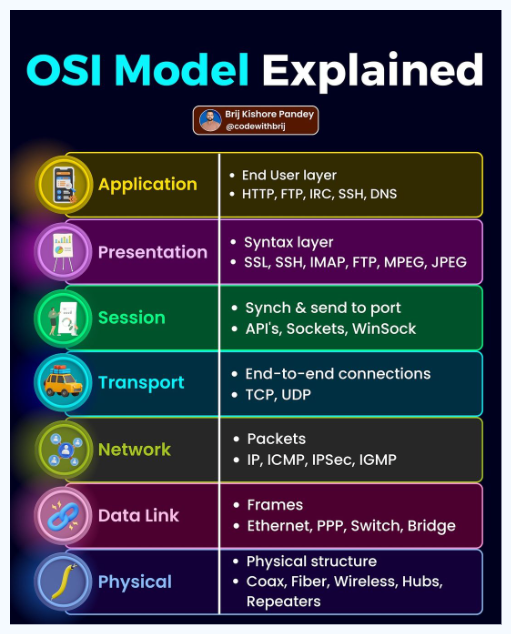
The OSI (Open Systems Interconnection) model is a conceptual framework for understanding network communications.
| Layer | Name | Function | Examples |
|---|---|---|---|
| 7 | Application | What the user sees | HTTP, FTP, SMTP |
| 6 | Presentation | Encryption, data format | JPEG, MP4, SSL |
| 5 | Session | Establishing/managing sessions | NetBIOS, RPC |
| 4 | Transport | Reliable delivery, flow control | TCP, UDP |
| 3 | Network | IP addressing, routing | IP, ICMP, Routers |
| 2 | Data Link | MAC addresses, frame handling | Ethernet, Switches |
| 1 | Physical | Physical transmission | Cables, Fiber, Hubs |
Layer Details
1. Physical Layer
The physical transmission of raw bits over a medium.
Components:
- Cables (Ethernet, Fiber optic)
- Hubs
- Repeaters
- Network adapters
Think of it as: The truck carrying the mail.
2. Data Link Layer
Handles node-to-node data transfer and error detection.
Key Concepts:
- MAC addresses
- Frames
- Switches
Think of it as: The envelope containing the letter.
3. Network Layer
Handles routing and logical addressing.
Key Concepts:
- IP addresses
- Routers
- Routing tables
Think of it as: The address on the envelope.
4. Transport Layer
Ensures reliable data delivery between hosts.
Key Concepts:
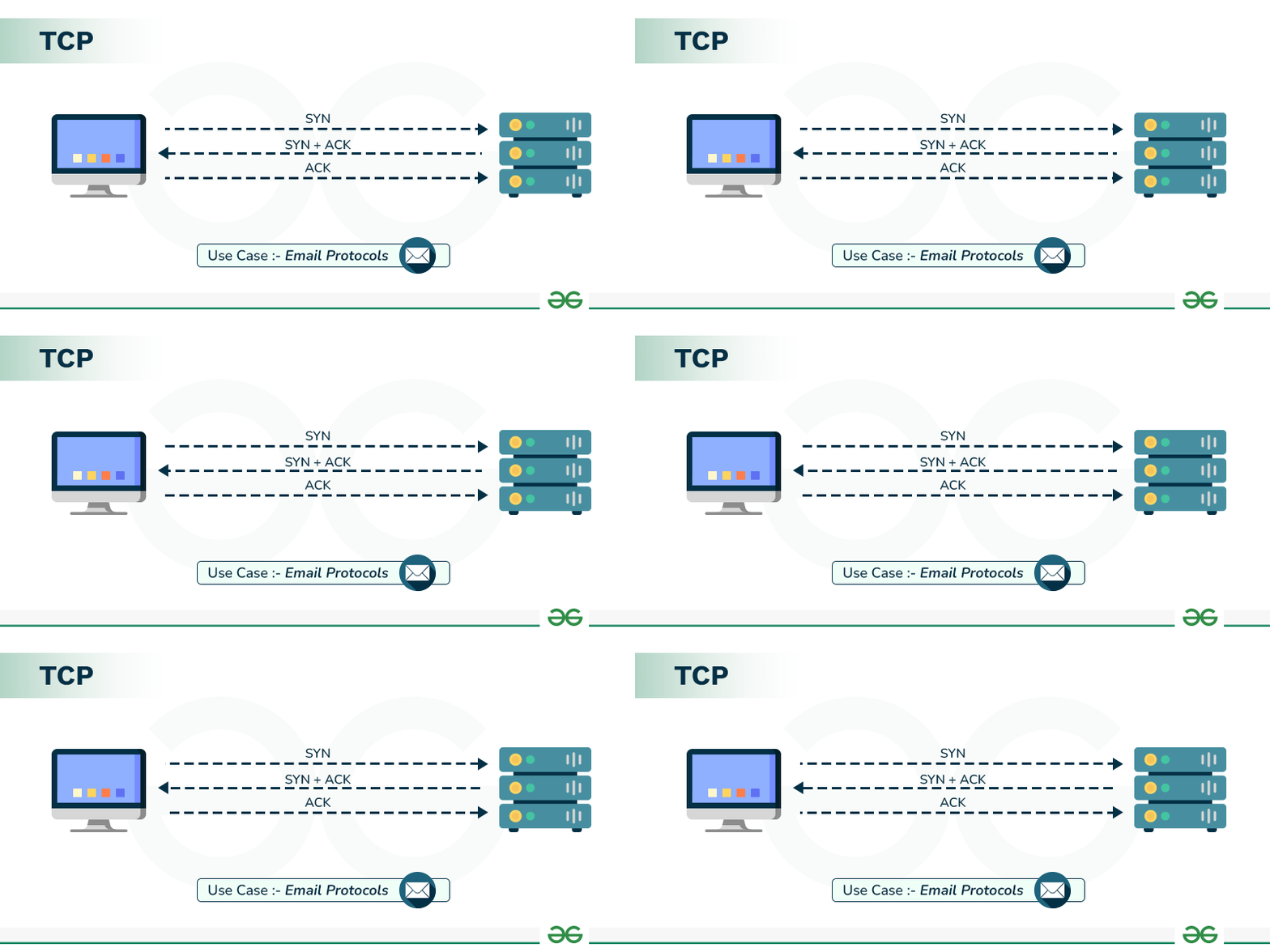
- TCP (reliable, connection-oriented)
- UDP (fast, connectionless)
- Port numbers
- Segmentation
Think of it as: The guarantee of delivery.
5. Session Layer
Manages sessions between applications.
Functions:
- Session establishment
- Session maintenance
- Session termination
6. Presentation Layer
Translates data between application and network formats.
Functions:
- Data encryption/decryption
- Data compression
- Format conversion (JPEG, MP4, ASCII)
7. Application Layer
The interface between the user and the network.
Common Protocols:
- HTTP/HTTPS (Web)
- FTP (File Transfer)
- SMTP (Email)
- DNS (Domain Resolution)
OSI vs TCP/IP Comparison
| Feature | OSI Model | TCP/IP Model |
|---|---|---|
| Layers | 7 | 4 |
| Development | ISO | DoD |
| Approach | Theoretical | Practical |
| Layer Separation | Strict | Flexible |
| Usage | Reference model | Internet standard |
Layer Mapping
| OSI Layers | TCP/IP Layer |
|---|---|
| Application | Application |
| Presentation | |
| Session | |
| Transport | Transport |
| Network | Internet |
| Data Link | Network Access |
| Physical |
Data Flow Through Layers
When data travels from sender to receiver:
Sender Side (Encapsulation):
- Application → Creates data
- Transport → Adds port numbers (Segment)
- Network → Adds IP addresses (Packet)
- Data Link → Adds MAC addresses (Frame)
- Physical → Converts to bits
Receiver Side (Decapsulation):
- Physical → Receives bits
- Data Link → Reads MAC, removes header
- Network → Reads IP, removes header
- Transport → Reads port, reassembles
- Application → Processes data
Key Takeaways
- OSI Model is theoretical (7 layers)
- TCP/IP Model is practical (4 layers)
- Data gets encapsulated going down layers
- Data gets decapsulated going up layers
- Each layer has specific protocols and functions
- Understanding these models is fundamental for networking